
Model context protocol (MCP) for enterprise AI integration
Over the past few years, AI adoption has exploded. Today, many companies are overwhelmed by the sprawling inventory of AI tools, raising integration, security, and governance issues. Standardizing on a single core orchestrator—Gemini Enterprise, Microsoft Copilot, ChatGPT Enterprise, Claude for Enterprise—has become a strategic priority.
This standardization raises an important question: how does your AI orchestrator interact with other business-critical AI tools? And how does it maintain enterprise security, governance and data access controls while interacting with AI technologies?
MCP: The key to unlocking AI value realization
Model Context Protocol (MCP) solves the thorny issues of enterprise AI adoption that keep executives awake at night. By applying a standard mechanism for connectivity between AI tools and their connection to data, applications and even other AI tools, MCP makes integration simpler, streamlines data security and access controls, and makes deploying AI models faster.
Strategy’s Agents are powered by our Universal Semantic Layer. This means that organizations can leverage decades of experience in best-in-class security and granular governance, down to row-level access in the fast-moving world of scaled AI adoption.
What exactly is Model Context Protocol?
The exploding AI ecosystem is creating a massive integration challenge. Every new AI model and enterprise application requires a custom connector to interact with your existing systems. It’s a complex and unsustainable approach.
Model Context Protocol (MCP) is the open-source standard built to solve this.
MCP acts as a universal adapter, defining a single, secure protocol for any AI application to communicate with any application, whether it's a CRM, database, or analytics platform.
Instead of building and maintaining a tangled web of connectors, you can adopt one unified standard. This dramatically reduces complexity, accelerates AI deployment, and, most importantly, provides a single point of governance for consistent security across all AI-driven actions. As your enterprise tools evolve, they all plug into the same standard.

Powering enterprise AI with Strategy
Nearly two-thirds of organizations describe their AI usage as “Pilot phase”, while a small percentage describe their efforts as “Scaling” or “Fully Scaled.” The challenge isn’t the AI models, it’s the data, the security, and the fears of inaccuracy.
How can a sales agent support your team with confidence when even simple concepts like “customer” and “region” are siloed in different systems and defined inconsistently?
Building custom point-to-point connectors for each is an integration and comprehension nightmare. What if you could add a layer on top of real-world data complexities that contain not just business friendly semantics, but also designed from the ground up to empower AI?
This layer would have business-friendly meanings, and would be built to support AI.

That’s where Strategy Mosaic fits. Mosaic provides a universal semantic layer that sits on top of your entire data ecosystem, every cloud warehouse, database, CRM, ERP, and unifies it. Mosaic lets you define your core business definitions once, then passes this context to any human or machine that needs to access the underlying data.
Now, when an AI Agent connects to your data, it isn't hitting complex and varied data sources. It speaks to your trusted and governed source of truth, greatly improving AI’s accuracy and maintaining enterprise level data governance – the top risks that organizations encounter on their AI journeys.
Strategy AI agents and MCP: Powering context-aware AI
Strategy Agents unlock conversational, proactive insights from your underlying business data. Each agent is configured for specific use cases, leveraging both structured and unstructured data.
By understanding your semantic layer, these agents provide context-aware answers. Our agents fully utilize the enterprise governance that Strategy has built through years of experience. For example, when an account executive queries sales data, the agent responds based strictly on that account executive’s access rights.
Uniting Strategy Agents, Mosaic, and Model Context Protocol enables your organization to unlock scaled, transformative AI adoption. This brings data driven insights to wherever your users need it most, while providing governed access.
“Our partnership with Strategy has significantly enhanced our data capabilities, and I believe we're on the forefront of an AI revolution.”
— Joe Simrany, Director of Integrated Insights, Pfizer
Strategy provides single tenant MCP server architecture for all our customers, connecting your enterprise orchestrator LLM dynamically to data insights sourced from Mosaic with fine-grained access control.
In practice, this means your accounting group can interact with Gemini Enterprise, ask natural language questions about financial data, and get insights from Strategy. In the meantime, your sales team interacting with Gemini only sees data scoped to their accounts, all within a consistent experience, monitored by Mosaic Sentinel’s enterprise-level security.
MCP in action: A real-world example
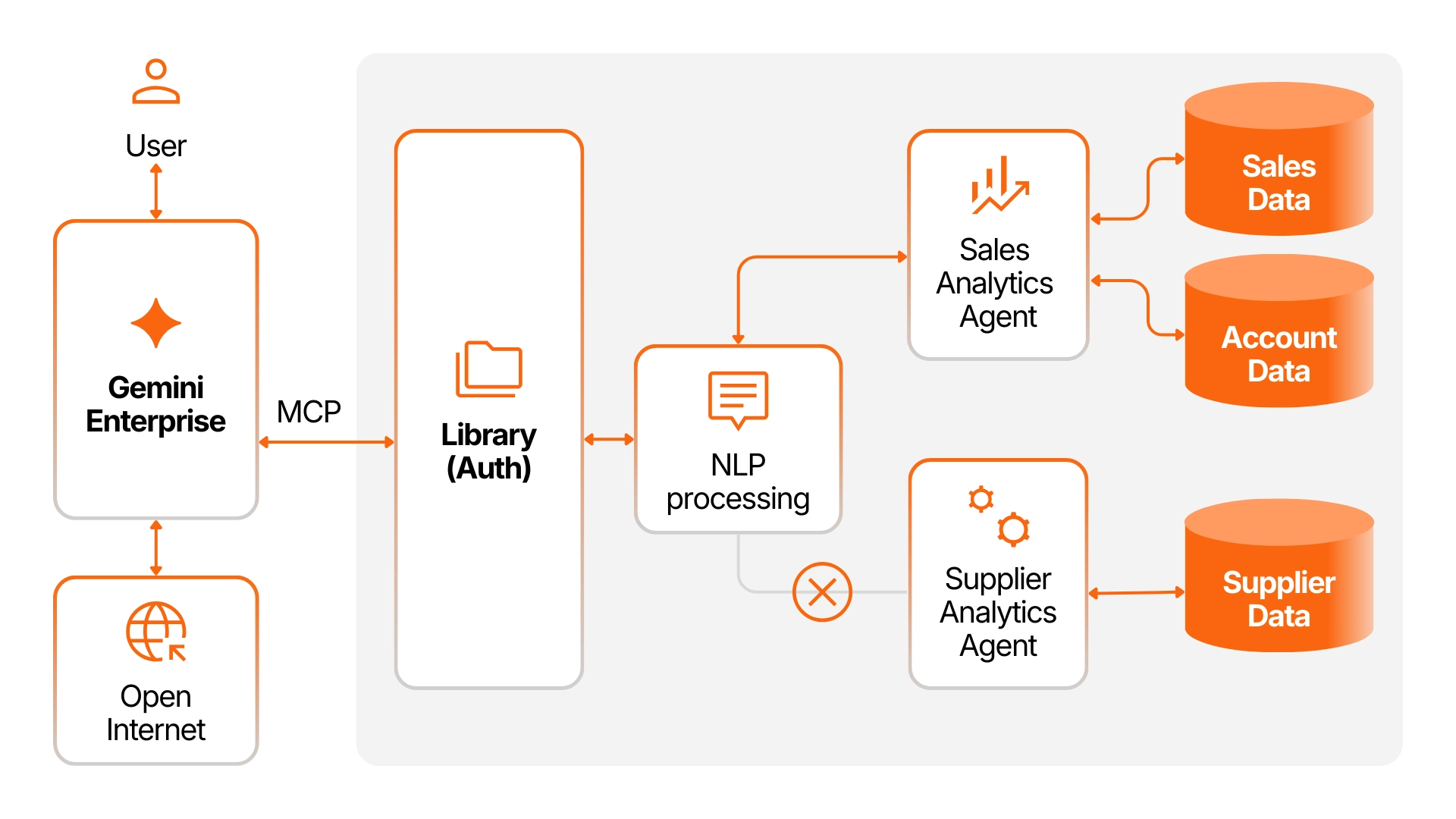
A major US based retailer deployed Strategy as their semantic layer across the organization and built dedicated agents for both Sales Analytics and Supplier Analytics. The company used Gemini Enterprise as the common AI orchestrator for all employees.
- Mikal, a US Northeast branch management, asks Gemini: “Sales are down in most of our stores in MA but how does this compare to the rest of the region?”
- Gemini analyzes this question. Because Strategy Agents are connected via MCP, it knows to route the request to our MCP Server for enterprise insights, while using its native capabilities to search the open web for broader context.
- Strategy MCP receives the natural language request, authenticates Mikal, and validates that he has access to the Sales Analytics Agent, but not the Supplier Analytics Agent.
- The Strategy Agent translates the query, pulls sales data for Northeast stores Mikal is authorized to view, and recognizes, based on prior queries, that he’s looking for month-over-month comparisons. Contextual insights show that the downturn is only in coastal stores in MA, RI, and CT. It is not seasonal based on past trends.
- Strategy passes this information back to Gemini, which correlates it with web data, identifying there was a strong winter storm last week in the region. This likely explains the drop in sales and is not indicative of a wider trend.
This is a simplified example illustrating the power of data-driven AI insights for all of your users, from the C-Suite to the frontline. This allows your business to be more agile and make decisions with confidence.
Transform your enterprise with Strategy
Ready to unlock secure, scalable AI adoption for your organization? Discover how Strategy Mosaic, Agents, and MCP can unify your data landscape, accelerate insights, and maintain enterprise-grade governance.

Aidan Reilly
Aidan is a Director of Product Management at Strategy, where he focuses on AI and developer experience. Bringing a decade of product and integration expertise, he has a strong passion for tackling challenging problems. Previously, Aidan drove product initiatives at Appian and Bloomberg.
Related posts

Explore the differences between Mosaic and Power BI’s semantic model, and discover how a universal semantic layer unifies analytics, governance, and AI across the enterprise.

The MicroStrategy Team
November 30, 2025
Discover how Strategy Mosaic, the world’s first Universal Intelligence Layer, revolutionizes data management with AI-powered modeling, tri-open architecture, and built-in governance for scalable, future-ready analytics.

Tanmay Ratanpal
July 7, 2025
Discover Strategy Mosaic, a 2026 Trend-Setting Product by DBTA, revolutionizing data management with its Universal Semantic Layer for consistent, governed insights across platforms. Transform your data into a trusted, AI-ready asset today.

Beata Socha
December 10, 2025

Discover Strategy Mosaic—the AI-powered Universal Intelligence Layer that unifies your data ecosystem. Eliminate silos, enforce governance, and deliver consistent, trusted insights across every BI tool. Future-proof your data strategy and accelerate AI adoption with Mosaic.

Lauren O’Connor
July 30, 2025