
Mosaic vs. Power BI’s semantic model: The technical reality behind unified vs. siloed intelligence
Widespread use of multiple BI tools can lead to inconsistent metrics, fragmented security, and isolated AI capabilities. A unified semantic layer offers a path toward consistent governance and enterprise-wide data intelligence.
1. The problem: semantic sprawl
In modern BI ecosystems, semantic sprawl happens when different teams or departments define their own version of the truth.
Tools like Power BI, Tableau, Qlik, Excel, may store their own business logic and metric definition, security rules etc. Tools like Power BI, Tableau, Qlik, and Excel often maintain their own business definitions and metrics within separate semantic models. This fragmentation leads to inconsistencies and drift, forcing teams to manually reconcile differences, a process that is both error-prone and costly.
2. Mosaic Universal Semantic Layer
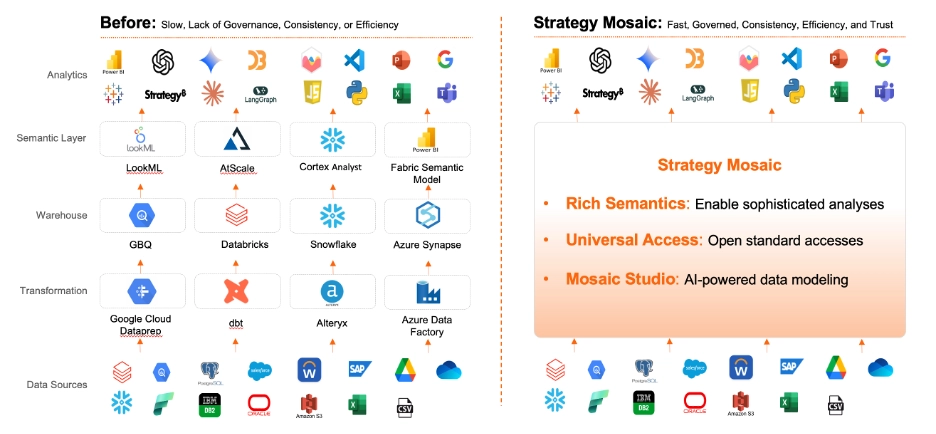
Mosaic isn’t just another embedded semantic model. It is an external, platform-neutral semantic layer that unifies analytics and data logic across your entire enterprise. Mosaic connects directly to virtually any data source, constructs a governed semantic representation, and exposes that unified model to diverse consumers—BI tools, programming environments, and AI systems.
Semantic graph as a core abstraction
At the heart of Mosaic lies a core semantic layer, which captures all analytical entities—logical views, metrics, attributes, relationships—in a structured, metadata-rich format. Unlike flat semantic models, Mosaic stores relationships explicitly, allowing it to represent complex interconnections among entities. It accommodates multi-form attributes, such as different representations of a customer’s identity (e.g., “First Name,” “Full Name” etc.), and treats advanced metrics formulas like conditional logic, level-based calculations, and composite formulas as first-class, reusable objects. This rich modeling layer is consistent and accessible across all applications that consume it.
Federated query execution with pushdown optimization
Mosaic is engineered for query federation, meaning it can join and aggregate data across multiple heterogeneous systems, such as Snowflake, Databricks, Google BigQuery, and on-premises Oracle, without forcing full data centralization. Intelligent pushdown ensures filters, joins, and aggregations are executed at the source, minimizing data movement and maximizing efficiency. This distributed compute approach enables performant analytics at scale while respecting data locality.
Centralized security and governance
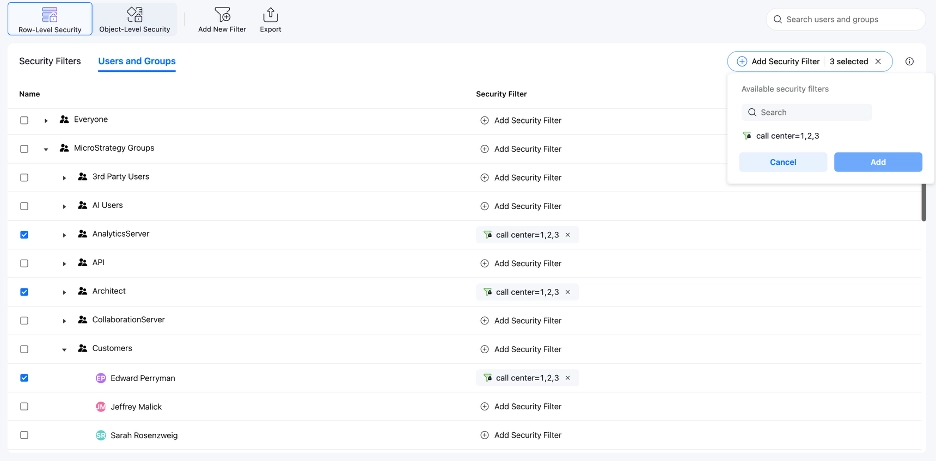
Unlike models that bind security logic to individual tools or embed it in SQL, Mosaic defines row-level and column-level access control policies directly in the semantic layer. These rules are injected dynamically into query logic, ensuring consistent enforcement regardless of which tool or interface is querying the data. Whether a user accesses the data from Power BI, Tableau, Excel, Google Sheets, SQL-based tools, or via custom-built APIs, the same centralized security policy applies without duplication or drift.
Multi-protocol interoperability
To ensure universal consumption, Mosaic serves its semantic layer through multiple industry-standard protocols and interfaces. These include:
- SQL/JDBC, for traditional BI tools and SQL clients
- XMLA/DAX, enabling native integration with Power BI
- REST APIs and a Python SDK, for custom applications and programmatic access
- MCP (Model Context Protocol), a planned AI agent protocol support for future extensibility
This flexibility ensures that Mosaic does not force a proprietary interface and can integrate seamlessly into any enterprise analytics and AI application stack.
3. Power BI semantic model
Not truly universal: The DAX barrier
Power BI's semantic model isn't truly universal because its logic is built on DAX, a proprietary language primarily understood only within the Microsoft ecosystem. While powerful, DAX isn't a common tongue for other BI tools. This creates information silos where business logic is trapped.
- Siloed metrics: If you use Tableau, Qlik, or even Excel for different analyses, any key performance indicator (KPI) or complex measure built in a Power BI model must be manually recreated from scratch in each of those other tools. There is no shared layer for governance, leading to redundant work and a high risk of teams reporting different numbers for the same metric.
- Isolated AI: This language barrier also extends to artificial intelligence. Power BI's Copilot can interpret DAX and provide insights, but that intelligence is confined to the Power BI environment. External AI systems cannot tap into or reuse the semantic logic defined in a Power BI model, hindering the development of enterprise-wide AI workflows.
Not independent or portable: Locked into the Microsoft ecosystem
The semantic model is neither independent nor portable because it is tightly coupled with Microsoft's architecture. The models are defined within .pbix files or Fabric datasets and are specifically optimized for VertiPaq, Microsoft's own in-memory engine. You can't simply lift this model and run it elsewhere.
- Fragmented security: This lock-in means security rules like Row-Level Security (RLS) are not transferable. Security policies defined within a Power BI dataset must be duplicated across every other BI platform, which complicates operations and creates potential security gaps.
- Inefficient architecture: Because the model isn't portable, each Power BI dataset must contain its own materialized copy of the data. This forces organizations to store duplicate data slices across multiple reports and workspaces, leading to higher storage costs, more frequent data refreshes, and increased compute loads. While XMLA endpoints allow external tools to query a Power BI model, they don't change the fact that the model itself remains a captive of its specific Power BI workspace.
4. Feature-by-feature breakdown
Aspect | Mosaic Universal Semantic Layer | Power BI Semantic Model |
Deployment | Cloud agnostic, external to BI and productivity tools | Azure Only, embedded within Power BI/Fabric |
Supported Protocols | JDBC, XMLA/DAX, REST, Python SDK, MCP (planned) | Primarily XMLA/DAX within Power BI |
Metric Types | Simple, compound, conditional, level-based, multi-form | Primarily simple & calculated measures in DAX |
Query Federation | Cross-source pushdown (Live and Import) | Single source per dataset (DirectQuery or import) |
Security | Centralized RLS, CLS ACLs applied across all tools | RLS/CLS scoped to dataset in Power BI |
AI Integration | Semantic and data served to AI via REST/Python/SQL; support for MCP (planned) | AI (Copilot) limited to Power BI environment |
Governance | Enterprise-wide across BI, AI, and apps | Confined to Power BI workspace boundaries |
5. Why this matters for enterprises
If your organization uses only Power BI and has no plans to integrate other analytics or AI platforms, the Power BI semantic model might be sufficient.
But if you:
- Use or plan to use multiple BI/Analytics/Data tools (Power BI, Tableau, Excel, Google Sheet, SQL clients, custom apps etc.) now or in the future,
- Want centralized governance for metrics, security, and metadata,
- Need AI systems to consume trusted business logic directly,
then Mosaics Universal Semantic Layer may help you tackle those challenges.
6. A Universal Semantic Layer for the enterprise
A semantic model defines the meaning of a data point. A universal semantic layer defines the meaning for the enterprise. Power BI’s semantic model is powerful within its own walls, but it remains a room in a single building. Mosaic is the city’s central blueprint, connecting every building, road, and utility with the same rules, definitions, and security. In a world where AI and analytics span multiple platforms, only a universal layer ensures everyone’s speaking the same data language.

The MicroStrategy Team
We provide powerful software solutions and expert services that empower every individual with actionable intelligence.
Related posts
Discover why an AI-powered semantic layer is essential to healthcare’s data-driven future. Learn how Strategy Mosaic unifies fragmented systems, ensures governed clinical metrics, enhances patient outcomes, and builds an AI-ready data foundation across the enterprise.

Lauren O’Connor
December 3, 2025
Discover how a universal semantic layer is the missing link in enterprise AI success. Learn how Strategy Mosaic unifies data, aligns KPIs, and delivers trusted, AI-ready insights across every system—eliminating silos, ensuring governance, and accelerating intelligent decision-making.

Tanmay Ratanpal
October 28, 2025
Unlock seamless data access and insights with Mosaic, the world’s first Universal Intelligence Layer, launching in June 2025. Discover how Mosaic enhances flexibility and agility in your data infrastructure, supporting AI and analytics across any platform.

Beata Socha
June 23, 2025
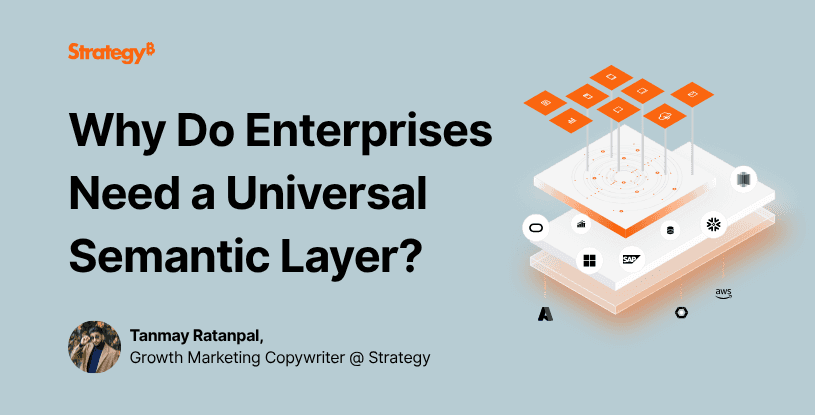
Discover why enterprises need a universal semantic layer to transform data into actionable insights. Mosaic, the next-generation semantic layer, offers consistent, real-time data access, enhancing decision-making and operational efficiency in the AI era.
Tanmay Ratanpal
June 18, 2025