
Scaling data & AI at goeasy with a Universal Semantic Layer
goeasy, one of Canada’s leading non-prime consumer lenders, has transformed trusted information into a strategic asset. By leveraging a unified data strategy, they’ve scaled data impact across retail banking, loan underwriting, and branch operations.
Read on to discover the strategy behind goeasy’s data journey, their early work with agentic AI, and why they chose to be an early adopter of Strategy Mosaic.
We recently sat down with Jide Adeoye, Director of Business Intelligence, to discuss how a universal semantic layer is fueling goeasy’s journey from legacy reporting to agentic AI.
Jide is a prominent voice in the Canadian business community, and recently co-authored the upcoming book Leading Change from the Inside: The Power of Black Employee Resource Groups in Canadian Workplaces alongside goeasy’s Chief People Officer, David Cooper. Proceeds from the book will support One Voice One Team, a youth leadership and community organization. His perspective on bridging the gap between technical architecture and business impact offers a masterclass for any data leader.
Semantics: An essential foundation for data-driven business impact
goeasy has built an impressive culture of data enablement, using Strategy for everything from executive reporting to retail branch operations. Looking at the full scope of that work, what achievements are you and your team most proud of?
There is so much to be proud of in terms of our data strategy’s success. One of the things I’m most proud of is our move to Strategy Cloud, which truly opened up seamless data access to our branch and store associates.
Before that, branch and store reporting was very manual. We distributed 30–50 reports per week via email, which local teams then spent 3-4 hours a day consolidating. When we ran the numbers, we estimated they were missing out on 10–15 loans per branch per week, which is time they weren’t spending with customers that adds up to millions in lost revenue opportunities annually.
"We’ve grown our user base 50x since 2017. Today, over 2,500 users rely on trusted data insights to drive business growth, powered by Strategy’s semantic layer."
On the cloud, we quickly scaled branch enablement dashboards out to the field, cutting their prep work down from hours to minutes. These solutions see 90,000 dashboard views per month—about a 3x increase. These solutions are additionally impactful because they integrate intraday data that refreshes 5–7 times daily, meaning branches call centers can see how they’re trending against targets throughout the day and adjust on the fly. Plus, by applying security filters, we were able to create one solution that allows each branch to see only its data.
Our widespread adoption has proven our impact. We’ve grown our Strategy users more than 50x since 2017. Today, over 2,500 team members either directly access Strategy or receive data through insights we distribute to our merchant partners that help them to reconcile volumes and commissions. The impact has been incredible.
How did using Strategy’s semantic layer as your unified data foundation contribute to the success of these solutions?
I’ve worked with a lot of BI platforms over the years: Cognos, BusinessObjects, SQL Server BI tools, and Oracle Business Intelligence Enterprise Edition (OBIEE). Strategy remains the most complete enterprise BI platform I’ve used—and its semantic layer is a big reason why.
Strategy’s semantic layer gives us one place to define and govern business logic, then reuse it across every report and dashboard. We built a trusted data model that captures the right relationships and reusable business definitions—attributes, metrics, filters, prompts, and more—so our data, analytics, and AI stay aligned and interpret the information the same way every time.
That consistency is what lets us scale confidently, because we’re not rebuilding definitions for every new use case. Moving to Strategy Cloud further amplified the impact of that foundation. When we were on-prem, we regularly added processing capacity to keep performance acceptable. In the cloud, shared resources across workloads have helped us maintain strong performance as usage and data volumes increased.
A great example is the EFS dashboard for easyfinancial, our personal loan division. It’s an “executive encyclopedia” owned by our Chief Risk Officer (CRO) with more than 1,000 KPIs and 35+ selectors, which was limited to a massive Excel workbook before Strategy. Our analysts would start refreshing the data on Sunday morning, then check again before dinner to see if it had finished. Even after running for 7-8 hours, it could still fail.
"After seeing our personal loan application with near real-time data insights deliver impact day after day, our Chief Risk Officer became one of Strategy’s biggest champions."
Strategy’s semantic layer allowed us to rebuild EFS as a near real-time application. Our data now refreshes reliably in about an hour, even with the volume and complexity. Our leadership was skeptical at first and didn’t think Strategy could handle something of that scale—but after seeing it working day after day, our CRO became one of Strategy’s biggest champions.
After EFS’s success, other executives started asking for their own solutions just like it. You don’t get that kind of reliable performance and repeatable scale without a strong semantic layer underneath, and that’s the foundation we’re excited to extend even further with Mosaic.
Mosaic: Scaling a Universal Semantic Layer as the lakehouse evolves
Why did you decide to open your semantic layer to new tools via Strategy Mosaic?
We chose to implement Strategy Mosaic because we’ve outgrown our enterprise data warehouse (EDW). We simply couldn’t wait until we fully rebuilt it as a data lakehouse platform to unlock the next level of value of our data or implement AI.
Our existing EDW is built on the SQL Server toolset, including SQL Server Integration Services and SQL Server Management Studio, which was designed for a limited set of reporting requirements. We patched our EDW over time to meet new demands, but it’s at capacity. To use an analogy: you know the proper fix for your car is expensive, so you keep paying for temporary repairs until the mechanic finally says you can’t take another patch.
We’ve now launched a next-gen data architecture program to rebuild our store for flexibility and scale. We are moving toward Azure Data Factory and Databricks, and we are evaluating options like Synapse or Azure SQL Data Warehouse. But re-architecting everything takes time, and we cannot put innovation on pause while we wait.
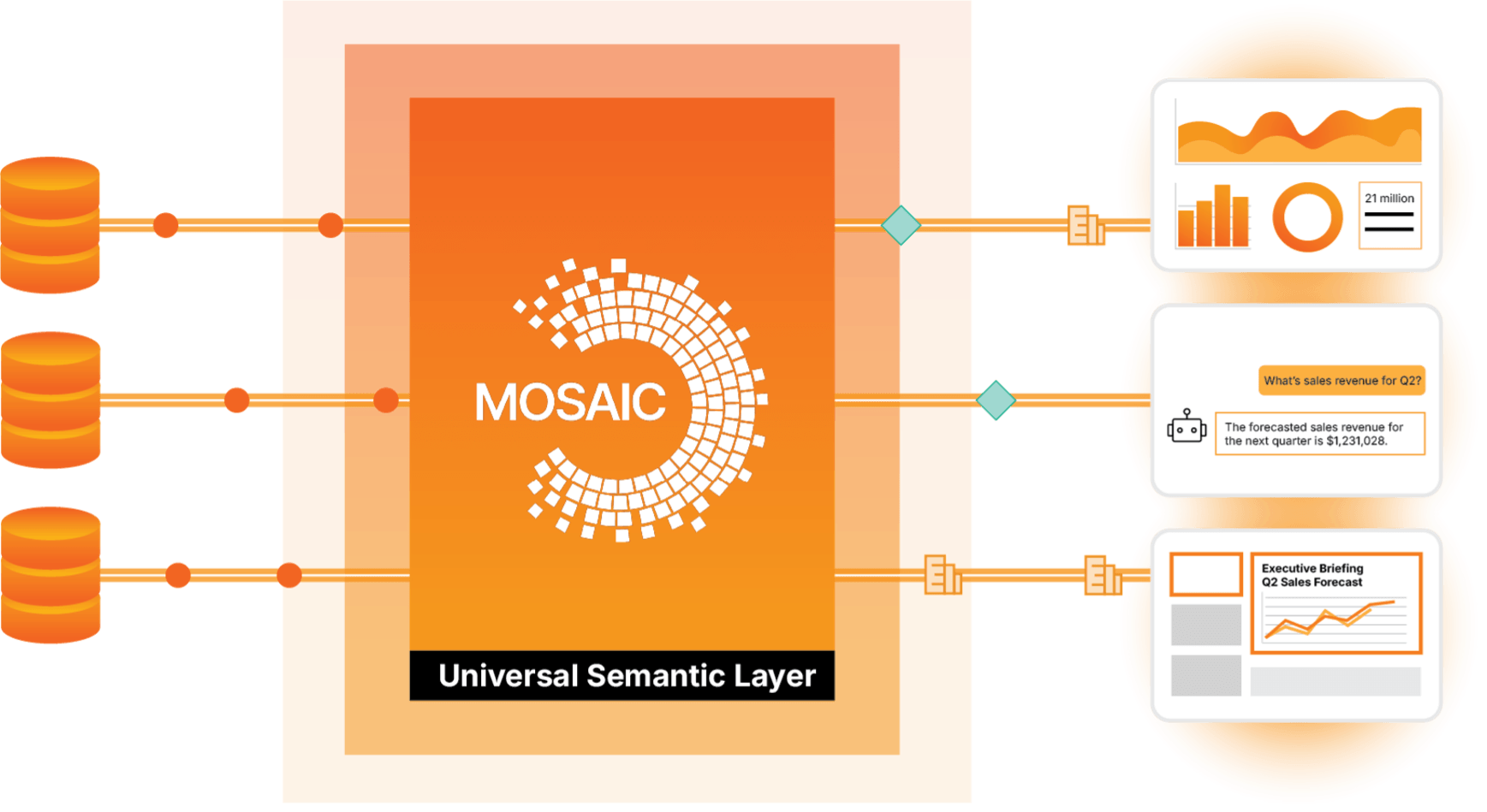
That’s where Mosaic comes in: it lets us open up Strategy’s semantic layer to new solutions and tools while our data stack evolves. Mosaic offers us a consistent data modeling and governance foundation. It gives us a way to connect new sources, model relationships, and deliver trusted KPIs without creating competing definitions across tools. Strategy will ultimately sit on top of our modern data stack, but we can continue to drive value with data and AI today using Mosaic.
How does Mosaic extend your existing data investments?
When I first saw a Mosaic demo, my immediate reaction was, “Can I have this yesterday?” I knew we had to find a way to fund it. I am glad we did, and we are proud to be among Mosaic’s early adopters.
We see Mosaic becoming goeasy’s enterprise data architect—a key architectural layer between the Strategy semantic layer we’ve already invested in and our next-generation data stack. We’re already migrating parts of our data processing and EDW to Databricks and Azure Data Factory, and Mosaic fits right into the middle of that journey. We’ll use Mosaic in a variety of ways, including to:
- Connect new data sources into our emerging data lakehouse
- Use consistent unique identifiers to understand how new sources relate to existing Strategy data
- Refine and rebuild KPIs in Mosaic as our understanding of the business evolves
- Generate join and indexing recommendations by surfacing patterns and optimization opportunities that guide how we structure and tune the future lakehouse.
Today, some processes rely on five or six joins when two would be enough if the tables were properly optimized. Mosaic helps us identify and correct inefficiencies in our data model, which matters even more on platforms such as Databricks where you pay per query. Fewer joins and better structures will translate directly into lower compute consumption and cost.
We’ve already seen meaningful cost savings from Strategy’s intelligent cubes because we are not hitting the database for every report run. Mosaic takes that principle further with in-memory processing and caching that can be leveraged across tools and use cases.
As we repoint data flows from SQL Server to Databricks and other Azure services, Mosaic helps make the transition more streamlined and cost-effective. It also preserves the consistent semantic layer business users already trust, and helps us reduce duplication as we integrate more data into our modern stack.
"Mosaic helps us correct inefficiencies in our data model. Consumption-based data platforms make you pay per query, so fewer joins and better architecture translate directly to lower compute and cost savings."
Agentic AI: Achieving scale & trust with a Universal Semantic Layer
What quick wins do you expect with Strategy Mosaic, and what’s next on goeasy’s semantic journey?
One of the first areas where we expect Mosaic to deliver meaningful value is LendCare, goeasy’s B2B lending arm. LendCare is a direct-to-merchant business with over 11,000 merchants across Canada, from OEMs to veterinary services, dental clinics, and even tattoo parlors.
Today, LendCare has its own data warehouse with 60+ reports and dashboards for performance and operational efficiency in Tableau. Right now, we’re maintaining two EDWs: any change requires updates in both our LendCare and easyfinancial warehouse, which is simply not sustainable.
We’ve just brought LendCare data into our environment, and now we’re working on repointing those Tableau reports to Mosaic, so our data insights are accurate, governed, and trusted. Eventually, we’ll transition LendCare off Tableau entirely, consolidating our solutions in Strategy.
Simply by repointing Tableau to Mosaic datasets in the short-term, we expect quick wins in a few key areas:
- Improving SLA performance with more timely data refreshes across our solutions
- Eliminating duplicative work across two warehouses, reducing maintenance and infrastructure costs
- Consolidating 60+ reports onto a much smaller set of reusable datasets, and eventually dashboards
Our data lakehouse isn’t ready to plug in an AI platform and expect reliable results. Everyone says, “AI is only as good as the data you give it” and it’s completely true. If your data isn’t structured and trustworthy, AI can’t fix that. Without Strategy’s semantic layer, we’d be two years away from starting an AI proof of concept.
Semantic layers are essential for generative AI. How has Strategy’s universal semantic layer helped you accelerate agentic AI initiatives?
Our first AI proof of concept focuses on a very practical, high-value workflow: managing daily returned payments and delinquency.
Today, that process is highly manual. Branch teams pull lists from banks and data from our systems of record, including sources that aren’t yet in our EDW. They spend hours every day consolidating everything just to answer basic questions, like who’s on the returns list, how many times have they defaulted, and which client a rep should contact first.
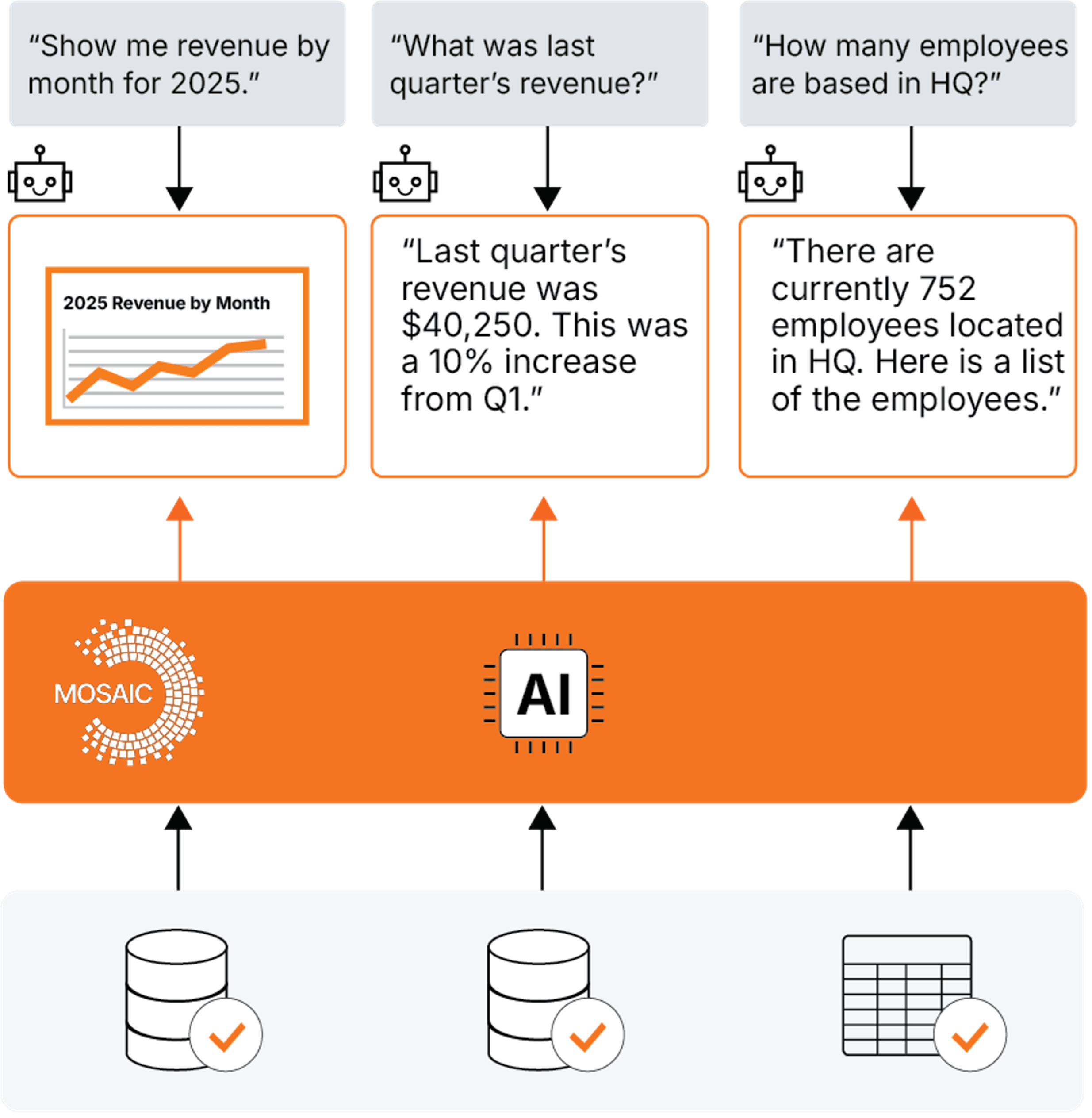
Strategy’s semantic layer consolidates all of that data into a single cube, with an AI agent on top of it. Before, branch teams could spend four to five hours each day manually pulling files and stitching sources together just to get to a workable returns list.
We’re already seeing value from our AI POC for daily payments returned, eliminating manual data consolidation so branch staff can refocus on customers and growth. They can answer those same questions quickly and consistently in 10 to 30 minutes, moving from data prep to taking meaningful action much earlier. Our channel enablement colleagues are validating our AI solution to make sure everything is correct—then we’ll pilot our agent with select branches before rolling it out to all locations.
With Strategy, our data lakehouse doesn’t have to be perfect. We can structure and consolidate our data now, experiment with AI today, and use what we learn to design our architecture for future impact. And as we expand with Mosaic, that same governed semantic foundation becomes easier to extend to more tools and use cases.
As a data leader, what advancements in semantic-powered AI are you most excited to bring to life at goeasy?
I’m particularly excited about what agentic AI can do for our loan application and adjudication processes.
Today, underwriting involves many manual steps. Some steps will always require human judgment, but many are repeatable and rules-based. Customers can’t wait hours or days for a loan decision, and we should be spending our people’s time on higher-value work instead of routine processing.
Semantic-powered AI agents can change that model. By automating meaningful parts of the underwriting flow on top of governed, trusted data and definitions, we can deliver loan decisions faster—making underwriting more consistent and efficient while improving customer satisfaction.
The next step is scaling that model across underwriting, servicing, and beyond, always grounded in a universal semantic layer that keeps AI aligned with accurate, well-governed data. As we expand with Mosaic, we expect to extend that governed semantic foundation to more tools and use cases.
What’s the long-term vision for goeasy’s data journey?
Longer term, we believe Mosaic will also be central in consolidating data that spans our LendCare, easyfinancial, easyhome, and executive reporting solutions. We will also use Mosaic to feed AI agents with trusted data, and power custom AI-enabled applications that run on our single universal semantic layer.
At goeasy, Strategy’s semantic layer has already helped us expand data from 50 users to 2,500+ across Canada, plus thousands more when you consider our merchant network. We’ve cut branch reporting prep from hours to minutes, recovering an estimated 10–15 loans per branch per week. We’ve transformed a fragile 7-hour Excel “encyclopedia” into a 1-hour, executive-grade dashboard. Our AI proof of concept has already reduced a 4–5-hour daily process for branch employees to mere minutes.
With Strategy Mosaic, goeasy is extending that semantic backbone across new tools, modern data platforms like Databricks, and additional businesses such as LendCare, while laying the groundwork for semantic-powered AI agents across the enterprise.
Customer stories that inspire
Each year, dozens of customers share their success at Strategy World—our annual user conference for Strategy practitioners and data enthusiasts.
The event brings together the best in data, analytics, and AI—including Jide Adeoye, who will share the latest about how goeasy is driving business impact with semantic layer-powered AI.
Want to connect live?
Register for Strategy World 2026 today to hear our latest customer stories live in Las Vegas from February 23-26, 2026.
.png&w=750&q=75)
The Strategy Team
We provide powerful software solutions and expert services that empower every individual with actionable intelligence.
Related posts
Discover why enterprises need a universal semantic layer to transform data into actionable insights. Mosaic, the next-generation semantic layer, offers consistent, real-time data access, enhancing decision-making and operational efficiency in the AI era.

Tanmay Ratanpal
June 18, 2025
Vendor lock-in quietly erodes data value. Learn why independence at the semantic layer is critical to avoid rigid stacks and future-proof analytics and AI strategies.

David Peterson
January 19, 2026
Discover how Strategy Mosaic transforms the semantic layer into a Universal Intelligence Layer—AI-ready, tool-agnostic, and built for the modern data stack.

Beata Socha
June 17, 2025
See how enterprises scale secure, governed AI with Strategy Mosaic—the universal semantic layer that unifies data governance, security, and compliance across tools, clouds, and platforms. Learn how centralized control ensures consistent, AI-ready insights without duplication or risk.
Beata Socha
October 6, 2025