
Building trust and governance into your data and AI organization
As enterprises scale AI adoption, governance is becoming the key determinant of trust, compliance, and long-term value. Forrester Research shows that a strong data and AI operating model can turn governance from a regulatory burden into a strategic advantage.
Governance as foundation
“A well-defined operating model and organizational structure is essential for enterprises aiming to scale innovation, manage risk, and drive business value with data and AI.”
— Forrester Research in The Data, AI, and Analytics Organization and Culture Model (2025)
The report identifies governance as one of the cornerstones of sustainable AI success. It safeguards organizations from fragmented decision-making and ensures that data and AI initiatives remain aligned with both ethical and strategic priorities. When governance is built into the operating model, it becomes a source of resilience, enabling responsible growth at scale.
Regulatory readiness
There is no denying the fact that enterprises face growing regulatory and ethical scrutiny. Data governance is front and center for a growing number of organizations.
“A well-structured data and AI operating model supports data governance, AI ethics, and compliance with laws like GDPR or the EU AI Act. It reduces risks related to data misuse, bias, and lack of transparency, protecting both reputation and operations.”
— Forrester Research in The Data, AI, and Analytics Organization and Culture Model
This readiness requires more than policy statements. It calls for mechanisms that define how data is collected, processed, and deployed, and by whom. Clear ownership and transparent processes reduce risk by ensuring consistency across teams and systems. A unified framework makes compliance verifiable rather than assumed, protecting the organization’s integrity as AI regulations evolve.
Shared accountability
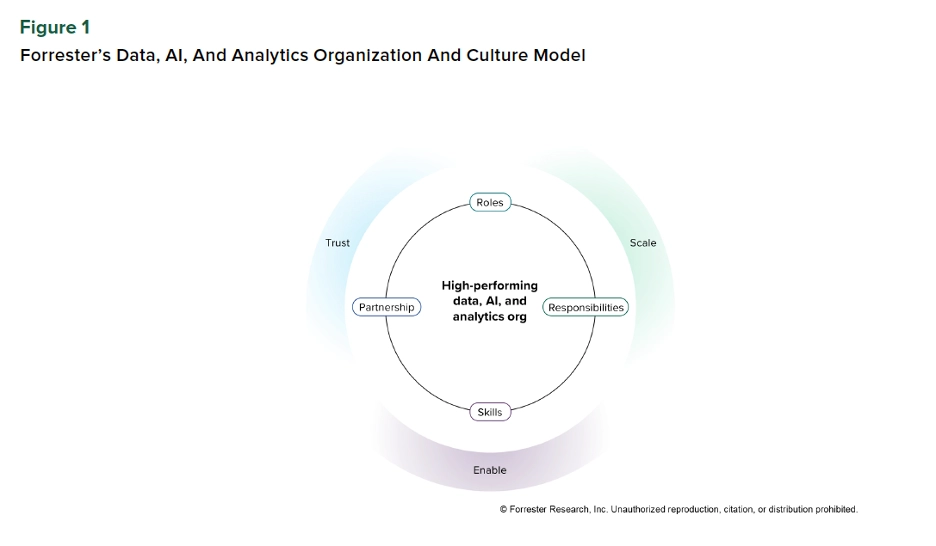
Strong governance depends on clarity of roles. Forrester emphasizes that aligning business, IT, and data teams accelerates decision-making while reducing duplication of effort. When responsibilities are explicit, collaboration becomes the default mode of operation, not an exception.
Equally critical is building a workforce that understands both the power and the limits of AI. Cross-functional skill development, data literacy, and open communication help teams act responsibly with data, turning compliance into confidence.
A culture of trust
Trust is not an outcome of technology but of transparency. Forrester Research proposes a model that connects governance with enablement and scalability, suggesting that organizations thrive when “data truth-telling” is protected and supported from the top down.
Embedding these principles creates an environment where innovation is not only faster but also safer. Governance, in this view, is not a constraint, it’s the structure that allows data and AI to deliver lasting value.
A resilient data and AI operating model transforms technology into enterprise advantage.
Read Forrester’s Data, AI, and Analytics Organization and Culture Model to learn how leading enterprises integrate governance, ethics, and trust into their data strategies.

Beata Socha
With over 15 years of experience as a tech journalist and content creator, Beata heads Content Marketing at MicroStrategy. An economics graduate, she specializes in finance and the impact of AI on business, bringing expert insights to the industry.
Related posts
Discover how a universal semantic layer is the missing link in enterprise AI success. Learn how Strategy Mosaic unifies data, aligns KPIs, and delivers trusted, AI-ready insights across every system—eliminating silos, ensuring governance, and accelerating intelligent decision-making.

Tanmay Ratanpal
October 28, 2025
Unlock the full potential of AI-powered analytics at scale by setting SMART goals and focusing on impactful use cases to drive measurable business outcomes, from increased productivity to cost savings and competitive advantage. Discover how industry leaders are maximizing their AI investments in the State of AI+BI Analytics Global 2025 Report.
Beata Socha
October 21, 2025
Ensure your organization's BI migration is seamless and strategic. Discover how to assess your readiness and avoid common pitfalls with our comprehensive guide.
Beata Socha
July 1, 2025
Discover how centralized, secure, and consistent data management improves decision-making, compliance, and AI readiness—powered by Strategy One’s Universal Intelligence Layer.
Tanmay Ratanpal
June 24, 2025