
Why most BI stacks fragment (and how leaders unify them)
Most executives think they have a "BI stack."
But what they actually have is a bunch of dashboards that don't talk to each other, built on a language that means different things to different teams.
Last quarter, three different teams presented three different revenue numbers in the executive meeting. Same data source. Same time period. Three completely different answers. Sound familiar?
This isn’t a dashboard or even a data quality problem.
This is a fragmentation problem, and it's costing you more than you think.
The structural issues causing BI fragmentation
Data fragmentation isn’t a surface-level issue. It’s an architectural one.
It often starts with how data is collected and processed and is usually discovered once it’s too late. By then, your teams don’t align, governance is non-existent, and decision-making stalls. Here are the five biggest reasons data becomes fragmented across the enterprise
1. Departments adopt independent BI tools
Every team has its preferred tool for collecting and analyzing data. Sales has its stack, marketing has theirs, and finance may use something else entirely. Over time, the way data is collected, stored, and processed becomes locked inside closed departmental loops.
As a result, datasets don’t align across teams, creating multiple versions of reports that cause chaos at the leadership level.
2. BI tools interpret data differently
Business intelligence tools like Power BI, Salesforce, or Qlik use different engines to process data. Definitions, calculations, and data relationships can vary, even if they connect to the same data environment.
Paired with fragmented datasets, this causes dashboards to show different results for the same KPIs. Teams view different answers to the same question, and decisions are made on a “ballpark number” instead of complete trust.
3. Semantic logic lives inside tools, not the enterprise
Semantic logic is the “glue” that defines how data is related, how metrics are calculated, and how insights are interpreted across the business. When each BI tool defines logic in its own language, teams don’t just struggle with broken dashboards. They duplicate effort, lose consistency, and introduce governance and accessibility risks that compound over time.
BI stacks don’t fragment because teams choose the wrong tools. They fragment because logic never leaves the tool in the first place.
4. Governance never scales across tools
When data logic is fragmented, governance breaks down with it. Policies applied in one tool rarely carry over to another. This creates massive gaps in access control, compliance, and reduces enterprise-wide oversight.
Unregulated data access increases the risk of breaches, leaks, and misuse. More importantly, it creates a data environment that you and your leaders can’t fully trust, undermining the whole point of data analytics for strategic decision-making.
Individually, these issues slow analytics.
Together, they break your BI foundation at every level.
The real issue is foundational, not structural
Each of the issues outlined above traces back to one core problem: the lack of data portability.
Data portability is the ability to move data and business logic across systems securely, while preserving consistency, governance, and control. When data isn’t portable, structural issues emerge, and long-term business risks begin to surface.
Direct cost of BI fragmentation | Long-term business risk |
Decision-makers revert to manual reporting due to constant misalignment | Loss of trust in BI dashboards |
Teams add more tools, purchase more licenses, and create operational overhead to “fix” gaps | Tool sprawl and rising total cost of ownership (TCO) |
Siloed datasets caused by poor portability lead to inconsistent AI inputs | Slower analytics and stalled AI initiatives |
Legacy BI tools continue to fragment logic over time | BI modernization becomes harder each year |
But when data is portable, BI tools translate data points into insights more efficiently. Teams receive consistent insights within their preferred applications, and every workflow remains governed by the same source of truth.
Many organizations try to solve this by introducing a traditional semantic layer. But most traditional semantic layers are either too rigid, too platform-specific, or too complex to support modern, AI-driven use cases.
Leaders who identify this are shifting their approach, turning towards a universal semantic layer to harness seamless data portability across tools, teams, and use cases.
Unify first, consolidate second: How leaders use the universal semantic layer
A universal semantic layer unifies data definitions, relationships, and metrics across BI tools and applications. It makes data portable and accessible within each team’s preferred workflow, without creating conflicting KPIs.
It centralizes governance by applying uniform access policies, enforcing consistency and compliance across the BI stack. As a result, your BI environment operates on a unified data foundation instead of disconnected, tool-specific datasets.
- Leaders gain a centralized semantic layer, shared across the organization
- Departments view consistent, reusable metrics for every dashboard and report
- Managers align reporting efforts across multiple applications (Power BI, Tableau, Excel, and custom applications)
- Enterprises build a stronger foundation for future AI initiatives
Strategy Mosaic takes this to the next level, combining data portability, governance, and AI inside a single foundation.
How Strategy Mosaic unifies the BI stack
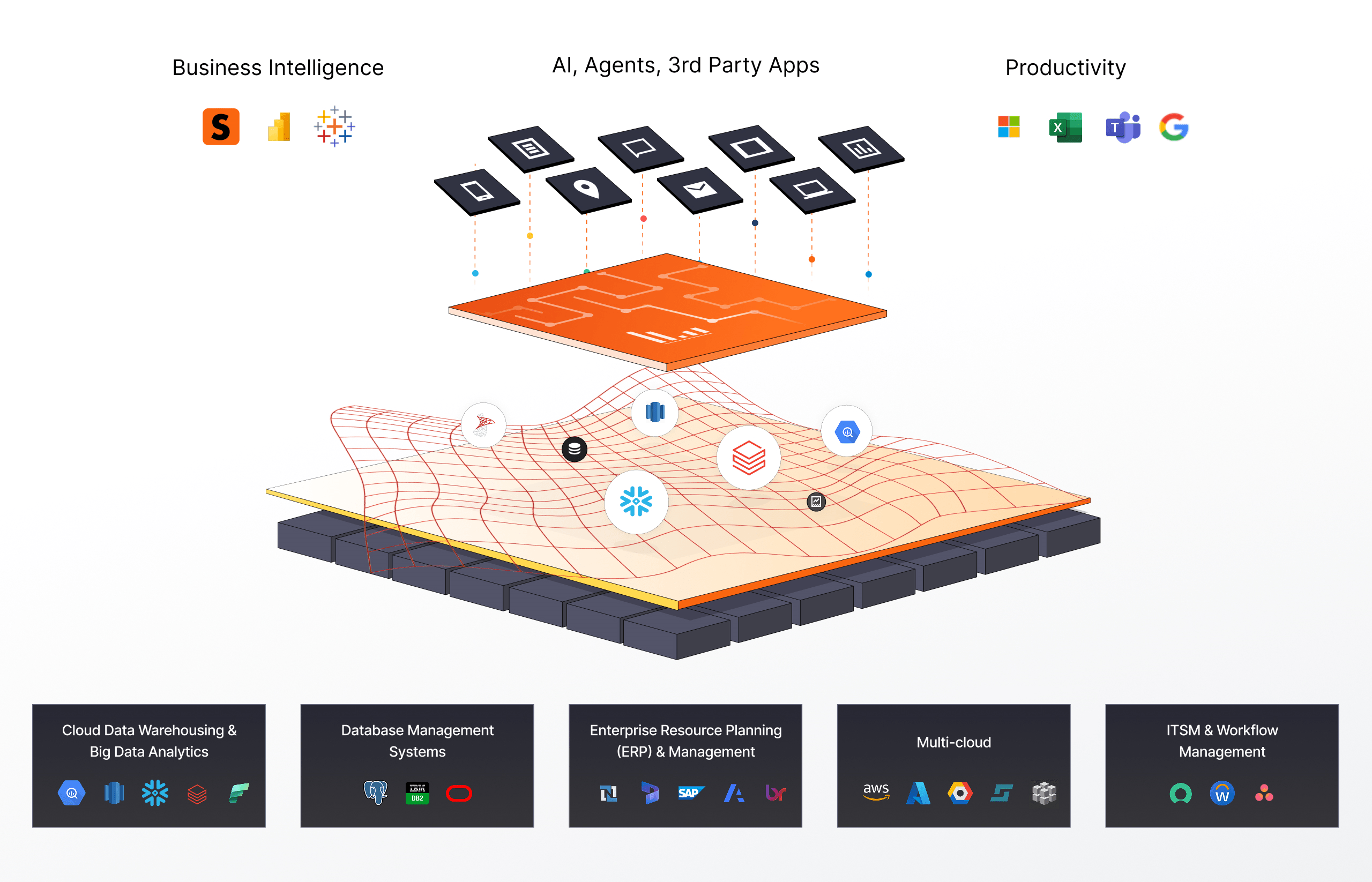
Strategy Mosaic doesn’t sit inside your BI stack. It sits above it, keeping logic portable as tools evolve.
Its universal connectors provide open, flexible access to 200+ data sources, so individual departments can connect their favorite tools and applications without reengineering from scratch. Business logic remains intact, even as the underlying stack changes.
It unifies business definitions, metrics, and relationships into one governed source of truth, making logic consistent across BI tools, cloud platforms, and data warehouses.
As a result, each user views accurate, consistent insights wherever they work. Executives track business health in real time, branch managers monitor performance against benchmarks, and frontline teams see insights as a decision is made.
Why a universal semantic layer is essential for enterprise BI
A well-managed BI stack isn’t defined by clean dashboards or unified reports. It’s defined by how usable the data logic behind them is.
If logic is fragmented, teams face conflicting numbers, siloed insights, and ongoing confusion, regardless of the tools or applications they use. Leaders who recognize this shift their focus from “fixing” dashboards to unifying semantic logic at the heart of their BI stack.
Strategy Mosaic does exactly that, connecting data systems and providing a governed, secure foundation for BI initiatives. It helps enterprises unify data logic without rebuilding environments or duplicating metrics.
Simply put, Strategy Mosaic doesn’t just help your dashboards talk. It helps each team speak the same language and understand the context, while restoring trust in the BI stack you rely on.
Discover how Strategy’s universal semantic layer brings data portability, governance, and consistency to BI ecosystems.

Tanmay Ratanpal
A copywriter and brand strategist with 8+ years of experience turning ideas into compelling content. He blends sharp messaging with smart storytelling to build brands that connect, spark conversations, and (mostly) win your boss’s approval.
Content:
- The structural issues causing BI fragmentation
- 1. Departments adopt independent BI tools
- 2. BI tools interpret data differently
- 3. Semantic logic lives inside tools, not the enterprise
- 4. Governance never scales across tools
- The real issue is foundational, not structural
- Unify first, consolidate second: How leaders use the universal semantic layer
- How Strategy Mosaic unifies the BI stack
- Why a universal semantic layer is essential for enterprise BI
Related posts

Why data governance must evolve for the AI era. Learn how Strategy Mosaic Sentinel delivers real-time, semantic, AI-ready governance to reduce risk and scale trusted AI.

Erika Moreno
December 18, 2025
_for_enterprise_AI_integration.png&w=3840&q=60)
Unlock the full potential of AI in your enterprise with Model Context Protocol (MCP), a universal adapter that simplifies integration, enhances data security, and accelerates AI deployment by standardizing connectivity across AI tools and business applications. Discover how Strategy Mosaic and MCP can transform your data landscape, providing context-aware insights and maintaining enterprise-grade governance.

Aidan Reilly
December 10, 2025
Discover Strategy Mosaic, a 2026 Trend-Setting Product by DBTA, revolutionizing data management with its Universal Semantic Layer for consistent, governed insights across platforms. Transform your data into a trusted, AI-ready asset today.

Beata Socha
December 10, 2025

Explore the differences between Mosaic and Power BI’s semantic model, and discover how a universal semantic layer unifies analytics, governance, and AI across the enterprise.

The MicroStrategy Team
November 30, 2025