
Why data quality is key to AI success in 2026
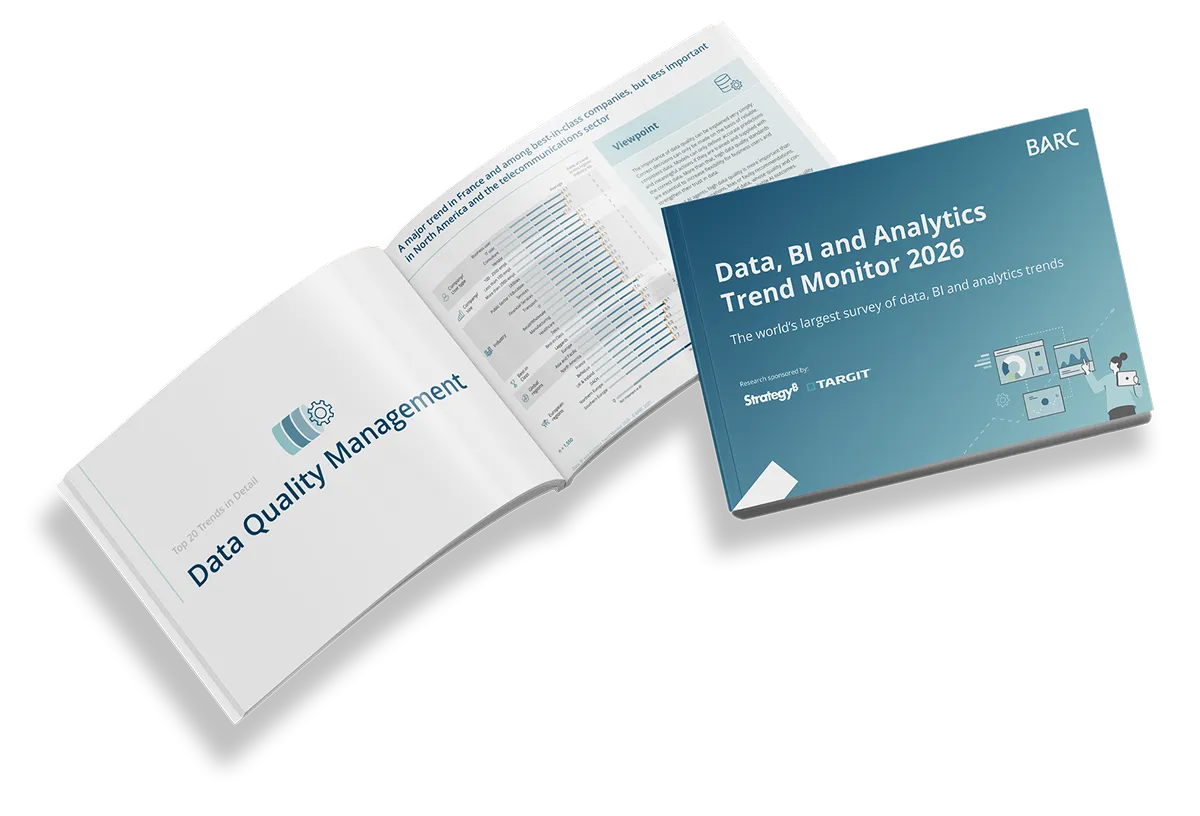
AI has pushed boundaries of what is possible in analytics over the past few years. New architectures, emerging agentic systems, and an explosion of generative capabilities. However, the multitude of scrapped AI initiatives across the board points to one common, recurring data that makes AI projects fail. As The Data, BI and Analytics Trend Monitor 2026 points out, no amount of innovation matters without high-quality data.
Data quality management reclaimed the number one position among all respondents, reinforcing a reality that has become hard to overlook.
“Correct decisions can only be made on the basis of reliable, consistent data.”
No substitute for foundation
In practical terms, this means the industry is moving past the assumption that better algorithms can compensate for weak foundations. The report highlights that hallucinations, biased predictions, and inconsistent recommendations often stem from noisy, incomplete, or poorly governed data.
This includes structured data flowing through operational systems, but also the rapidly expanding universe of unstructured data: text, documents, images, logs, that now plays a central role in training and refining large language models and generative applications.
As the report notes,
“For AI and AI agents, high data quality is more important than ever to avoid hallucinations, bias or faulty recommendations.”
Margin for error narrows
Ensuring the quality of these inputs requires a different level of rigor, transparency, and lifecycle management than many organizations initially anticipated.
As AI initiatives move from proof-of-concept to production, the emphasis on data quality becomes even more pronounced. Pilot environments can tolerate imperfections because their purpose is exploratory; production environments cannot. Once an organization expects employees, customers, or automated systems to rely on AI outputs, the margin for error narrows considerably.
It is at this stage that teams discover how quickly data inconsistencies undermine trust, adoption, and ultimately the business case for AI. The report is explicit on this point:
“Trustworthy, well-governed data remains the foundation for all further innovation.”
The scaling pitfalls
A persistent misconception in the market is that modern AI models are inherently resilient to imperfect inputs because of their scale. The opposite is proving true. The larger and more complex a model becomes, the more sensitive it is to subtle inconsistencies and the more costly those inconsistencies become when replicated across automated processes.
This is especially visible in generative AI applications, where training data quality directly shapes tone, accuracy, and reasoning capabilities. The report makes this link explicit:
“High data quality standards are essential to increase flexibility for business users and strengthen their trust in data.”
— BARC, The Data, BI and Analytics Trend Monitor 2026
Organizations exploring agentic AI are seeing the same pattern: autonomous systems require clean, well-structured metadata in order to interpret context correctly, orchestrate tasks, and deliver reliable recommendations.
Lineage transparency & metadata quality
This shift is reflected in the types of investments leading organizations are making. Rather than limiting quality efforts to one-off cleansing initiatives, they are embedding continuous monitoring into pipelines, formalizing data quality metrics, implementing anomaly detection systems, and defining clearer accountability across domains.
They are also expanding the scope of data quality practices to include metadata quality, lineage transparency, and contract-based expectations for data producers. These steps are not merely operational housekeeping; they represent a strategic framework for ensuring that AI systems receive the level of signal integrity required for dependable decision-making.
Strong data quality controls reduce this risk and form the backbone of responsible AI governance practices. Without them, monitoring, explainability, and remediation efforts become significantly more complex.
Data culture and literacy
There is also a cultural dimension to consider. Many organizations still struggle to articulate clearly who owns the quality of specific datasets and what “good” actually means in measurable terms.
The organizations making the most progress are those that treat data quality as a shared responsibility rather than an IT function. They invest in data literacy, communicate quality expectations consistently, and embed quality checks into both upstream and downstream workflows. This alignment becomes increasingly important as data products, data meshes, and self-service analytics models gain adoption, distributing responsibility across more teams than before.
New old priorities
Ultimately, the renewed prioritization of data quality reflects an industry that has matured beyond early experimentation. AI is becoming operational, embedded, and consequential. As a result, organizations no longer view data quality as an optional enhancement but as the structural prerequisite for scalable AI. The systems they are building—decision intelligence frameworks, conversational analytics platforms, automated workflows—depend on accuracy, consistency, and clarity at every layer.
The data confirms what practitioners have been experiencing firsthand: the AI landscape is expanding, but the foundation required to support it is becoming more demanding, not less. Organizations that recognize this and invest accordingly are establishing an advantage grounded not in hype, but in readiness. Those that continue to defer data quality improvements will find that even the most advanced AI tools cannot compensate for weak inputs. The industry’s message is unmistakable—without quality, there is no intelligence to scale.
Don’t let AI innovation outpace your data foundations.
Read BI and Analytics Trend Monitor 2026.
The Data, BI and Analytics Trend Monitor 2026 was conducted by BARC in the summer of 2025. A total of 1,579 individuals participated in the survey. The study sheds light on current trends, challenges, and strategies in the field of data, BI and analytics and provides in-depth practical insights across industries, regions and maturity levels. For more information, please visit: Data Decisions. Built on BARC.

Beata Socha
With over 15 years of experience as a tech journalist and content creator, Beata heads Content Marketing at MicroStrategy. An economics graduate, she specializes in finance and the impact of AI on business, bringing expert insights to the industry.
Related posts

Power your AI strategy with 7 essential components to drive real outcomes. Learn how Strategy helps you align, activate, and scale with confidence.
Beata Socha
May 13, 2025

Smash data silos and drive results! Discover how Strategy’s Semantic Graph unifies data, AI, and analytics to power smarter business decisions.
Beata Socha
April 29, 2025
Unlock the full potential of AI-powered analytics at scale by setting SMART goals and focusing on impactful use cases to drive measurable business outcomes, from increased productivity to cost savings and competitive advantage. Discover how industry leaders are maximizing their AI investments in the State of AI+BI Analytics Global 2025 Report.
Beata Socha
October 21, 2025
Discover why data governance is the foundation of trustworthy AI in 2026. Learn how Strategy helps enterprises use governance frameworks and semantic layers to ensure accurate, compliant, and explainable AI-powered analytics across the business.
Beata Socha
October 7, 2025