
The disconnect between AI innovation and AI reality
If 2025 has made one thing clear, it’s this: the gap between new market entrants and what organizations actually need has rarely been wider. Tens of thousands of new AI startups are flooding the market promising transformation in the form of new AI technologies.
But the reality is that organizations are not AI ready and have increasingly realized the need to focus on strong data foundations and organizational culture first.
Data quality and culture
The Data, BI and Analytics Trend Monitor 2026 published by BARC shows that business users overwhelmingly prioritize the elements required for trustworthy, everyday decision-making. Vendors, meanwhile, favor technologies that promise future scalability or differentiation. The difference in emphasis is striking, and consistent across the core trends.
“The gap between vendors and users continues to be visible in 2026. Business and IT users place the highest emphasis on data quality management, data security & privacy and data-driven culture, reflecting their need for trustworthy data and compliance in daily operations.”
— BARC, The Data, BI and Analytics Trend Monitor 2026
Let’s take data quality management, which scored as the top priority overall in the 2026 ranking. Business users rate it at 8.1/10, firmly in the mission-critical territory. Meanwhile vendors assign significantly lower importance of 7.0.
While organizations are dealing with messy, inconsistent, siloed data that directly undermines analytics and AI initiatives, vendors tend to assume that foundational data issues can be addressed along the way, or solved by tooling. Users know it can’t.
“At Strategy, we were fortunate to have placed data governance at the heart of our platform for decades. Over the past two years, we have increasingly added AI to our platform but more importantly, we have increasingly improved our ability to fuel external AI agents with our governed data layer. This is critical as the proliferation of AI agents will require a single view of data if they are to deliver consistent results across platforms.”
— PeggySue Werthessen, VP Product Strategy
A similar pattern appears for data-driven culture, one of the hardest capabilities to build (ranked third overall). Business users rate it 7.4, while vendors assign it just 6.9.
Culture change: literacy, trust, shared responsibility, communication, is a slow, nonlinear process. Vendors naturally focus on what can be shipped, while users focus on what must change for results to stick.
“The trust this the most humans would not refer to themselves as data driven. They are unlikely to wade through a mountain of data to find the answer to a question. However, if presented with the right information at the right time, data becomes a powerful tool which nearly anyone can leverage.
The promise of modern AI agents is that the answer to any question becomes immediately accessible by anyone regardless of their data skills. The more that we can integrate agents into the everyday workflow of users, the more that we can help organizations drive a more data-driven approach.”
— PeggySue Werthessen, VP Product Strategy
Data security and governance
Priority #2: data security & privacy, shows the same divergence. Unsurprisingly, IT users assign it the highest ranking (after all, they are ultimately responsible for security breaches and data leaks) of 8.0, closely followed by business users with a score of 7.9. Vendors lag with a rating of 7.4.
For organizations, security is not optional. Cyberattacks are getting more sophisticated, regulatory pressure continues to rise, and sensitive data moves through more systems than ever before. Users need airtight protection for daily operations; vendors tend to see security as a baseline feature rather than a leading differentiator.
Data & AI governance reveals a smaller, but still notable gap. IT users rate it 7.2, business users 6.8, and vendors 6.5.
This is not surprising. Governance is the connective tissue that ensures data is correct, models are monitored, and AI decisions are explainable. Without it, adoption stalls or gets blocked entirely by risk, compliance, and trust issues. Vendors, however, tend to frame governance as an add-on, something organizations worry about internally rather than a core part of the product story.
“One of the most important barriers to successful AI adoption will be the ability to assess the risk. It is well understood that many AI agent behaviors are non-deterministic – meaning that can behave in unexpected ways. When considering the use of data, this poses obvious risks. By placing proven enterprise grade governance at the core of your multi-agent architecture, you are able to trust that every agent will be held to the same guardrails.”
— PeggySue Werthessen, VP Product Strategy
Frontier vs. foundation
On the other hand, there are areas where vendors assign significantly more importance than business users. These are almost always innovation-focused trends:
- Advanced analytics / AI & ML: vendors 7.0 vs. users 6.3
- Generative AI for data & analytics: vendors 6.3 vs. users 5.5
- Agentic AI: vendors 5.2 vs. users 4.5
This is exactly what you would expect from companies selling tools that accelerate automation, drive scalability, and differentiate their platforms. But while none of these priorities are unimportant, organizations know they cannot skip the maturity steps required to adopt them responsibly.
“These results underline that trustworthy, well-governed data remains the foundation for all further innovation.”
Why this gap matters right now
The mismatch between vendors and users has real consequences. Many organizations are in the “pilot graveyard,” surrounded by AI proofs of concept that never made it into production. The root cause is consistently the same: the technology delivered does not align with the organization’s readiness, capabilities, or constraints.
This explains why so many AI initiatives fail to scale. Vendors supply innovation, but without sufficient reliability and a rock-solid foundation, even the most sophisticated and innovative AI projects will fail.
The 2026 BARC trend report reinforces the message that AI cannot compensate for weak data foundations, unclear ownership, or a lack of cultural readiness.
“The success or failure of AI pilots is caused by a number of factors. While data readiness certainly tops the list, there are a number of important considerations. Based on our experience deploying AI agents over the past two years, we have seen the greatest success from organizations that have first focused on setting a clear use case with clear goals. Rather than AI for AI’s sake, they carefully consider which workflows would most benefit from AI and how.”
— PeggySue Werthessen, VP Product Strategy
Interestingly, even where vendor and user priorities align, there is still divergence in motivation. For instance, both sides value self-service analytics, but for very different reasons: vendors see it as a means to accelerate adoption, while users see it as real empowerment.
Bridging the divide
Closing this gap requires more than better communication. Organizations need:
- Realistic roadmaps that reflect their maturity—not vendor assumptions
- Joint prioritization of foundations and emerging technologies
- Governance-first approaches that embed trust into every stage
- Capabilities-building, especially in literacy and culture
- Transparent vendor engagement, with clear expectations on both sides
The organizations that insist on foundations first will be the ones who actually scale AI. Meanwhile, the vendors who recognize this, and help customers move at the speed of readiness, not hype, will win the long game.
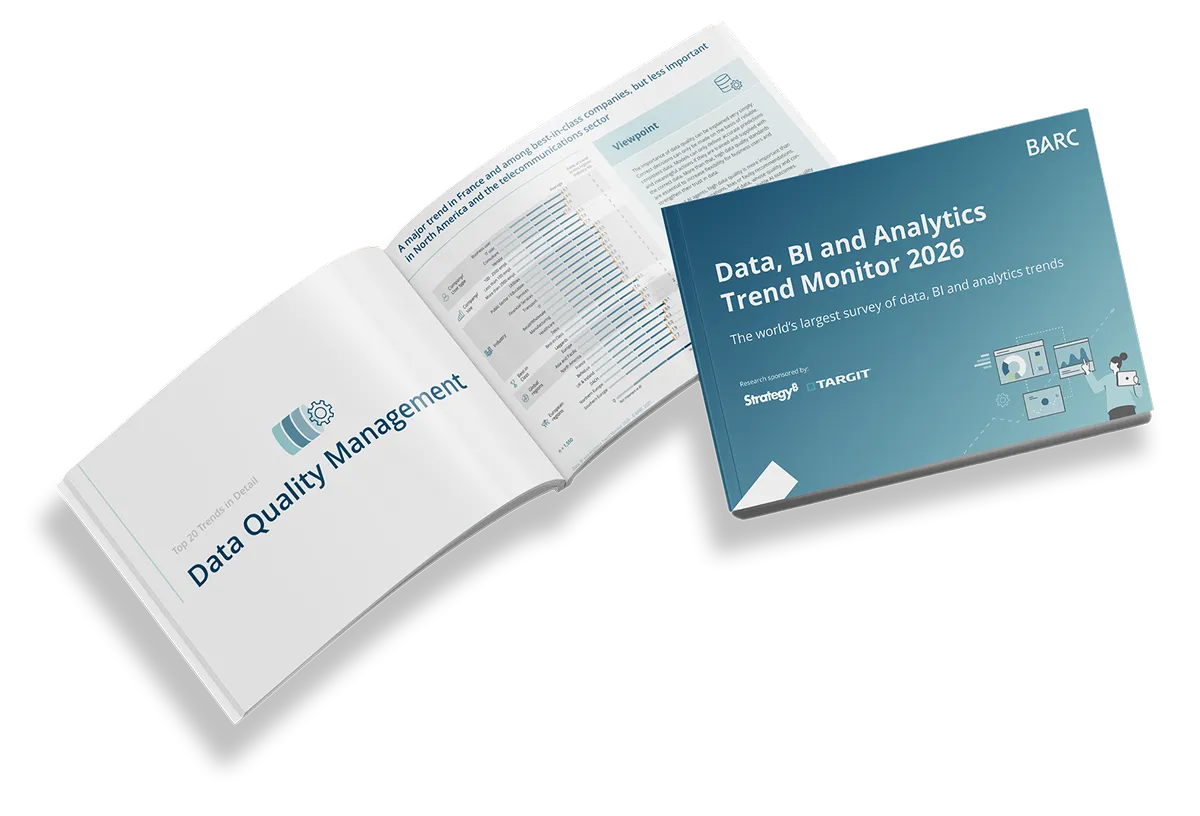
Don’t let AI innovation outpace your data foundations.
Read BI and Analytics Trend Monitor 2026.
The Data, BI and Analytics Trend Monitor 2026 was conducted by BARC in the summer of 2025. A total of 1,579 individuals participated in the survey. The study sheds light on current trends, challenges, and strategies in the field of data, BI and analytics and provides in-depth practical insights across industries, regions and maturity levels. For more information, please visit: Data Decisions. Built on BARC.

Beata Socha
With over 15 years of experience as a tech journalist and content creator, Beata heads Content Marketing at MicroStrategy. An economics graduate, she specializes in finance and the impact of AI on business, bringing expert insights to the industry.
Related posts
Discover how the Open Semantic Interchange (OSI) Initiative is revolutionizing enterprise semantics by fostering collaboration among industry leaders like Snowflake, Salesforce, and dbt Labs to establish a universal, vendor-neutral standard for semantic models, paving the way for consistent, reliable data insights across platforms.

Erika Moreno
November 13, 2025

Discover how Strategy enables AI-ready, scalable data architecture with Forrester’s six-stage model and the Universal Semantic Layer for enterprise success.
Beata Socha
November 11, 2025
Discover how a universal semantic layer is the missing link in enterprise AI success. Learn how Strategy Mosaic unifies data, aligns KPIs, and delivers trusted, AI-ready insights across every system—eliminating silos, ensuring governance, and accelerating intelligent decision-making.

Tanmay Ratanpal
October 28, 2025
Smash data silos and drive results! Discover how Strategy’s Semantic Graph unifies data, AI, and analytics to power smarter business decisions.
Beata Socha
April 29, 2025
Ensure your organization's BI migration is seamless and strategic. Discover how to assess your readiness and avoid common pitfalls with our comprehensive guide.
Beata Socha
July 1, 2025